‏إظهار الرسائل ذات التسميات protect. إظهار كافة الرسائل

Beware of Spyware


As time has gone by, increasingly more folks are conscious of what spyware is. While the amount of individuals out there who are alert of spyware almost certainly is not as high as those who know about anti-virus software, the disparity is definitely closing. Spy ware is an increasing difficulty which has been a key concern for the past few years. How do you get this stuff on your computer? What are a few of its characteristics, and what are a few of the factors which folks do not know very clearly about spy ware?

As indicated by the majority of individuals, spy ware is commonly deemed a type of malware that's put into somebody's personal computer without their consent or knowledge. As soon as the software has been put on somebody's computer, then the individual that planted it in their computer can do several things. One thing which can be accomplished is to look into and examine the user's computer behavior and habits. What possible benefit is this to the individual who plants the software on the computer of the unsuspecting user? One of these benefits is that the persons who installed the spyware use it to steal others' personal data, like bank and credit card records. The spies do that because they want the data so as to steal folks' money. In addition, certain criminals will take those details and sell it to third parties, who would like to steal access to that type of confidential information.

One more reason why individuals plant spyware in other people's computers is to trace where they go online. Obtaining those details can be useful to the spy and harmful to the individual that has had their data stolen. It is seriously important that you continually use and update your anti spy ware software so as to defend yourself. Not having and using this software may put your computer in a vulnerable condition. Spy ware can be so sneaky that you are probably not even aware that it's on your computer, and that makes it doubly important to use the proper tools in order to keep yourself safe.

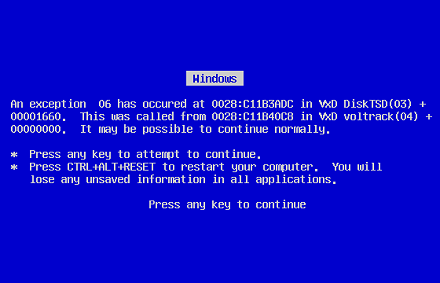
How to Prevent Blue Screen


Have you ever encountered that you computer falls to a blue screen? It is an unavoidable problem for the common user. Since a mass of reasons may cause such problem, you have to pay close attention to it. So, in this article, you can find some tips to prevent your computer from the blue screen.

First of all, do not load too many programs when starting in case system resource runs out. In the common circumstance, the system resource should not be less than 70% when there is no any application running. You ought to uninstall some of them to prevent the blue screen.

Second, backup the important registry files regularly in order to replace the file when the system goes wrong. As registry is significant database for the computer if it is broken or wrong, it is vulnerable for the computer to fall into blue screen.

And avoid shutting down the computer abnormally, because the abnormal shutdown of the computer may cause many important files such as DXD, DLL files lost. Such files are too specific and professional to backup or restore.

For most common users, it is unnecessary to upgrade the display card and drive programs, as the upgrading may harm the computer. At the same time, avoid installing the useless software and uninstalling or deleting applications manually. If you have to do it, be sure to uninstall and delete clearly and completely. Otherwise, it may create a lot of illegal displacing files and errors which may take up space and bring about many problems as well. And, if you do not have extremely large memory, you had better not run the applications simultaneously.


How to Secure Your Computer?

Computer security is extremely imperative for anyone who uses the internet. As there are millions of people using the internet for various purposes, they are exposed to a number of threats all the time. Viruses, malware, hackers etc. can access your system and misuse your data or information. It would not only hinder your privacy but may also cause some financial or material threats to use. However, to remain safe from such perils, there are a number of computer security measures which can help you to remain safe and work in a trouble free environment. Here are some measures which you need to take to secure your PC:

1. Firstly, it is vital to have anti virus program in your system. these software protect you against number of perils such as the attach of various viruses etc. they scan your system for any harmful stuff which may have entered it by means of the internet and thus purge your PC from it. Viruses can damage your files and lead to data loss which may create serious problems for you. Some viruses can damage your entire system as well. So have a good anti virus program and update is regularly.
2. It is also vital to use strong passwords and not to share them with others. Your passwords should be long so that hackers may not access your system and misuse your confidential data.
3. When you have to shop online, it is very important to use reliable e-commerce sites only. This is for the reason that there can be scams and when you give your personal information such as your credit card number, contact information etc. it can be misused. So shopping from reputable sites is imperative for computer security.
4. Making use of web browser as well as security functions of operating system can also help you to secure your system. You need to see to these features and ascertain that you are making use of the fully for computer security.
5. It is also very important to have backup data so that in case of any mishap, your information can be retrieved.

What Are Trojan Viruses Exactly ?


To those who spend hours on the Web, knowing the facts about Trojan viruses is a must. If you store personal info on your PC, learning to protect yourself from these programs is necessary.


Definition

Technically, these aren't viruses. These are actually programs / software. However their actions and purpose are the same as viruses. For average computer users, the definition isn't as important as knowing how to spot and eliminate them.


What the Viruses Can Do

Their activities are often called payloads or attacks. These are classified into different types. Remote attacks go after FTP or HTTP servers. They can interrupt downloading of files. These viruses can also interfere with server requests and other processes. These Trojan viruses can also hack into proxy servers.

Payloads aren't limited to networks. Once active they can destroy files on hard disks. Others will attack the boot system. Once this happens the PC won't be able to boot up. Others are able to get personal information and passwords. These are relayed to various sites via HTTP.

The Way the Virus Works

It's impossible to give a standard process. These are created by different programmers. They do share common characteristics though. The most important is that they operate in secret. Most of the time, users won't know it's been activated. Only when the Trojan viruses are doing their damage will it be apparent.

How the Viruses Get in a PC

One way is by downloading. A user downloads a game or other software. He or she is unaware that the virus is included in the software. When the game is run, the virus is installed with it.

Another way is through email. The virus is attached to the email. The user unknowingly opens it, infecting the computer. Often, the attachment is passed on to other users. The scenario repeats itself, and that's how it spreads.

Not to be discounted are pirate software. These come in DVD / CD or downloaded from the Web. Both sources are filled with Trojan viruses and other malware.

Protecting Yourself

Get an antivirus application. Install it and download the updates regularly. Run a virus scan whenever you download software. Never turn it off when you are online. Run a full virus scan at least every week. An anti spyware program will also help. Use it in conjunction with your antivirus software.

Always back up your documents. It should be done weekly at the very least. If your system is infected, run the virus scanner first. Don't back them up until your computer has been cleared.

Never open an email attachment without scanning it. Don't just rely on the email service scanner. Run one yourself. Needless to say, you should never use pirated software. Never install Active X or Java applets from suspicious looking websites.

Always read up on the latest news about Trojan viruses. You can never be too careful when it comes to your files. Take all the necessary precautionary steps as suggested. This will keep your data safe.